
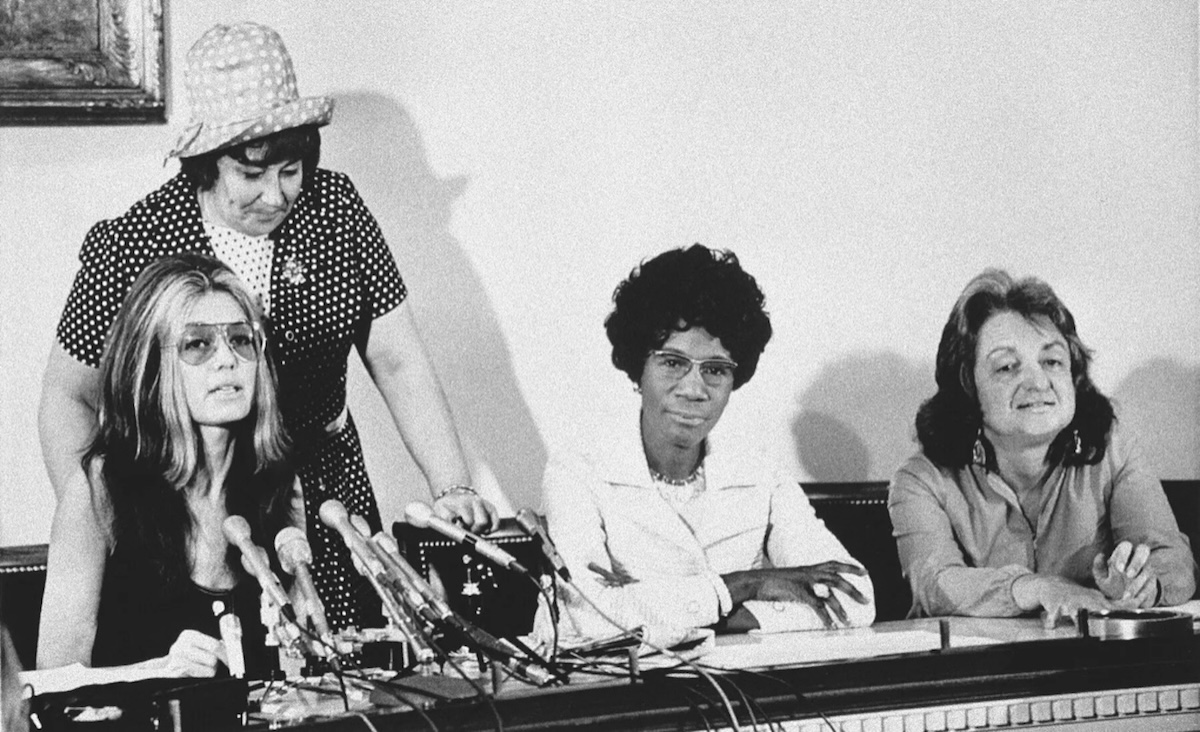

We are the glorias!
I posted this photo by Charles Gorry on Instagram last week, along with my thoughts and feelings about Gloria Steinem’s…
...
Having directed hundreds, if not thousands, of psychodramas over the years with people in recovery, I know that one of the biggest issues they face is shame. Some would say that shame is a leading cause of addiction. Some would say that it’s the biggest manifestation of it.
I could argue that it’s both.
As a result of all of my work in the area of shame, and my own personal healing from it, one of my greatest beefs with the language in the 12 Steps is the use of the term character defects. It’s in the literature, it’s talked about at meetings, and it’s specifically in step four, when describing how our “instincts have gone awry.”
It also shows up specifically in step six. The text of that step is that we “Became entirely willing to have God remove all these defects of character.”
Those are the words of Bill Wilson, who’s the co-founder of Alcoholics Anonymous, and the initial author of The Basic Text, sometimes colloquially referred to as The Big Book.
In psychodrama after psychodrama after psychodrama I’ve directed, it’s the shame that has driven the addict, and it’s often what leads them back to relapse. And the thought that I’m defective is what’s at the core of shame.
Let’s talk about the difference between shame and guilt. Guilt is, “I have done something wrong” – an action or a behavior of some kind. And in step nine of Alcoholics Anonymous, we get to make amends. We can not only apologize to someone for any harm that we’ve done to them, but also to make a commitment to change our behavior.
Shame, on the other hand, is a sense that at my core, I am wrong. I’ve heard dozens and dozens of people say a variation of one of these statements:
“How do I make amends for that?”
“How do I heal that?”
“Maybe I’m just a bad person and always will be.”
So, if the 12 Steps are telling me I’m defective, how do I get rid of that shame?
I know I have yet to meet someone with a history of addiction, whether they’re currently active in it or whether they’re in recovery, who hasn’t struggled with shame.
By the way, I’m using the term addiction generically here. Whether it’s an unhealthy relationship with alcohol, or drugs, or food, or sex, or love, money, work, etc – it doesn’t matter. It’s about the unhealthy ways that I have used that substance or that behavior, and the inability to stop.
For those of you who aren’t familiar with the 12 Steps, there’s an inventory that is done through Step 4, where you examine your resentments and your fears, and you also do a sex inventory. After you share that inventory with a safe person, typically your sponsor, you arrive at Steps 6 and 7, which are about being entirely ready to have all of those “defects of character” removed, and then humbly ask that those shortcomings be removed by a Higher Power. I haven’t quoted the language precisely, but that’s the gist of it.
And I want to be clear that I think the 12 Steps are extraordinary. They’ve saved so many people’s lives, and marriages and relationships. They have brought a sense of purpose to people; they have helped people change and grow; they have helped so many people heal, and helped so many people come back to themselves.
I’m not here to denigrate the 12 Steps. But the word defects has always bugged me. Now, I know enough about the history of AA to know that when he wrote the first draft of the basic text, Bill Wilson was looking to mix up the language so that he wasn’t using any particular words over and over and over again.
If it were up to me, the word defect would never have been used.
If I hadn’t learned how to use food or alcohol or workaholism to dissociate, to cope – and I’m talking about myself here – I might literally not be here today. And now you’re going to shame me by telling me I’m defective? I mean, come on. I’m not defective. I have defenses that I developed to help me cope and survive.
I call them character defenses.
Those self-protective responses were all I had at the time; they were all I knew to do to help get me through those difficult situations and feelings.
Rather than calling them defects or liabilities or shortcomings, in psychodrama, we would describe them as underdeveloped and overdeveloped roles.
Underdeveloped roles are the roles that we’ve either not developed, or are not engaging in enough, and that can often make our lives better if we did.
Overdeveloped roles are the ones that we’re engaging in too often, sometimes to our detriment.
Let’s use learning how to set and keep a boundary as an example. If I can set and keep a boundary, then that role might be defined as a healthy, boundaried person. Now, if that role is underdeveloped in my life, I might want to have a clear limit on what’s okay and what isn’t, but I’m expecting the other people to have ESP and know what I want to need, rather than being able to name it and keep that boundary.
But maybe nobody ever taught me how to set a boundary, or maybe I’m afraid to have boundaries because I’m afraid if I do, that I’ll be abandoned. maybe no one ever gave me permission, which is something that should have happened when I was a child.
Overdeveloped roles are the ones that I’m engaging in too often – to my detriment. If I’m constantly taking care of others at my own expense, that could result in what we call role fatigue, meaning I’m exhausted from that role. I likely need more balance in my life in the roles that are underdeveloped – self-care, for example.
When it comes to overdeveloped roles, Bill Wilson used the term liabilities, which isn’t particularly shaming and actually captures the gist of it. I much prefer that language, and wish he had used that term consistently to describe these behaviors.
So when someone is in active addiction, and again, I’m using that term generically to include both substances and process addictions, they are in the overdeveloped role of addict. And many, if not most of the other roles in their lives – husband, wife, partner, friend, child, sibling, co-worker, etc – most of those roles are not being used or they’re not being used in a healthy way. We all need balance.
When it comes to the underdeveloped roles, Bill Wilson used the term shortcomings, which is also non-shaming. We have fallen short of stepping into the roles in our lives. Not just one, but all of them.
And this is where psychodrama can be incredibly helpful, because we need to practice how to step more into the underdeveloped roles and how to learn to shift out of the overdeveloped roles, or at least balance them. We need to explore the fear that we might have about letting go of a role or stepping into a new one. We need support, we need resources or people in our lives who can help us explore all of this through action in the magic of a psychodrama session.
And with willingness, which is something that someone in recovery commits to in the first step, they become entirely willing. They can begin to parse through which of those defenses they might want to use and in which context, and which ones no longer serve them.
For example, from my own life, after living in New York City for as long as I did, I know how to step into the role of the, “Don’t F with me kind of energy.” It’s a protective posture I can use, and that way, if I’m in a situation that could be dangerous or a little scary, that protective role can serve me.
If, however, I walk around in that kind of posture everywhere else in my life, people are probably going to avoid me or steer clear of me, and I’ll end up alone. So in my own life, I had to learn when and where to be appropriately defended and where being so no longer worked for me. That’s a lifelong journey. It’s the hero’s journey, but it’s a journey worth taking.
The beauty of psychodrama is that as we are sorting through that, we can use action to step into and practice these new behaviors and beliefs. Which brings me back to the 12 Steps. One of my favorite slogans in those recovery rooms is, “I had to act my way into right thinking because I couldn’t think my way into right acting.”
The action has to come first. The action leads to the thought changing, not the other way around. So, rather than looking at behaviors or beliefs as a defect, people can be helped to look at them as defenses that they developed in order to cope with often really challenging situations, give themselves some slack for that, and work towards changing it.
My invitation for this post is to think about in which roles, or which circumstances, have you considered yourself defective instead of honoring your defenses that you developed to cope? And if you’ve been shaming yourself for some of those behaviors or beliefs, how can you start to let go of that overdeveloped role of self-shamer or self-blamer and step into the underdeveloped role of being much kinder to yourself?
It’s worth the journey.
This material may be protected by copyright.
_________________________________________________________________________________________________________________________________________
About Jean:
Jean Campbell, LCSW, SEP, TTP, TEP has been bringing together groups of people to heal for over 31 years. She blends her extensive experience in psychodrama, sociometry, group psychotherapy, somatic healing and trauma resolution to offer training for helping professionals, personalized intensives, clinical consultation, and leadership workshops. You can find her at theactioninstitute.com, on Instagram at @actioninstitute, and on Facebook at @actioninstituteofcalifornia.
Watch Jean’s TEDx Talk Psychodrama Demonstration
https://www.youtube-nocookie.com/embed/OdvErKtIVUE?rel=0&autoplay=0&showinfo=0&enablejsapi=0
I posted this photo by Charles Gorry on Instagram last week, along with my thoughts and feelings about Gloria Steinem’s…
...
As a follow up to my last post about chatbots, I’ve been thinking a lot about why they’re so popular,…
...