
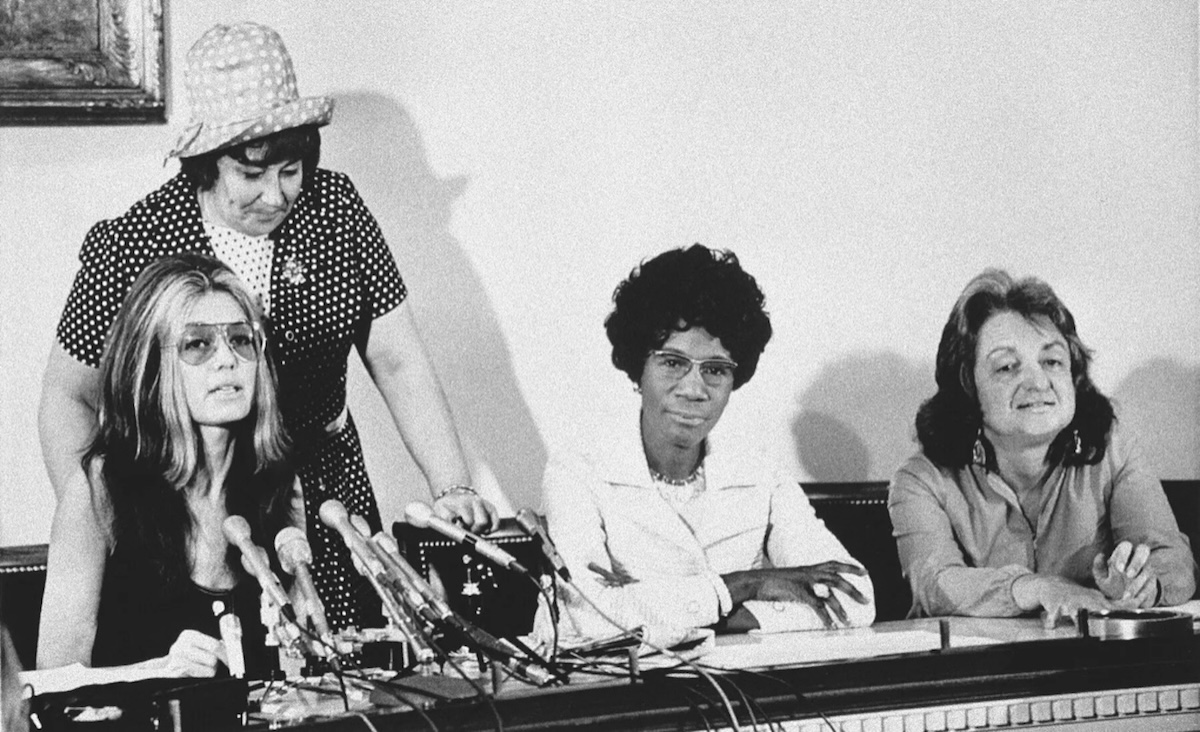

We are the glorias!
I posted this photo by Charles Gorry on Instagram last week, along with my thoughts and feelings about Gloria Steinem’s…
...
Most times when I try something new – or in the language of psychodrama – I step into a new role, I’m not very good at it. At all. Actually, I kinda suck at it. There’s a steep learning curve and lots of trial and error before I can own the role, and in the process of learning it and practicing it, it’s really easy for me to get discouraged and want to quit.
I find that’s even more true the older I get, because I’ve spent decades mastering skills, and on a day-to-day basis, I feel pretty solid in most of my roles. But when I start something new, it sucks to be a beginner.
That was certainly true when I learned how to ski.
Well, the truth is, I didn’t learn. I had no idea how to do it. I didn’t take a lesson, and what a surprise, I spent most of the day on my butt.
My ego was shattered, and at the end of the trip, when a friend of mine asked me how I liked skiing, I said, “I hate it.”
Well, I didn’t really hate it. I was just really bad at it. It looked so easy when other people did it, and I thought I should be able to just put on some skis, grab my poles, and gracefully shush down the mountain.
I couldn’t, and I had the bruises to prove it.
Like the vast majority of people on the planet, when I try something new, I need help learning how to do it. But because I was raised to pretend I knew how to do things, I also “hated it” because the only way I was going to get any good at it was to admit I didn’t know what I was doing, and take lessons.
Which brings me back to the topic of roles. JL Moreno, the creator of Psychodrama, believed that the larger our role repertoire – that is, the ability to step into an adequate response in a situation – the bigger my repertoire, the healthier I would be.
So what do I mean by a role? In Psychodrama, there are three types of roles: Somatic, social, and psychodramatic.
Somatic roles are any roles connected to the body or the soma. A sleeper, an eater, a runner, a swimmer.
Social roles are relational roles, sibling, spouse, parent, boss, friend.
Psychodramatic roles can be either wished for roles that are achievable or wished for roles that are complete and utter fantasy.
For example, when I started graduate school, I had the wished for role (psychodramatic role) of being a licensed therapist. I knew it was going to take time and learning and practice, but I also knew that I could aspire to it, which I eventually did.
On the other hand, when it comes to a fantasy wished for role, when I was a kid, I dreamed of being an Olympic gold medalist in swimming. I would imagine myself standing on the podium, gold medal around my neck, a bouquet of flowers in my hands, crying through the national anthem.
I competed in swimming as a kid, but I was nowhere near talented enough in that sport to ever make the Olympic team. But it didn’t stop me from dreaming, and dreams are a good thing.
Now that we’ve defined roles, let’s talk about what we in psychodrama call role training.
That is the process of taking on a new role, and I’ll preface this by saying that when I learned about role training, it allowed me to have much more patience with myself because when I step into a new role, it takes time to get good at it. It’s a rare thing to be exceptional at something the first time you do it, or even the 10th time.
Case in point: When the author Malcolm Gladwell wrote about this topic in his book Outliers, he said that on average, it takes about 10,000 hours of practice to master a skill. That’s a lot of time and a lot of practice…and a lot of mistakes, and a lot of opportunities to turn those mistakes into growth and mastery.
So let’s look at that process.
Role training happens in three stages.
When I take on a role – when I role take – I learn it by imitating what I’ve seen others do. I observe someone else, like I did a ski instructor. Yes, I did eventually take lessons.
So I watch somebody else do it, and then I do my best to imitate it. When I’m first taking on a role, it involves a lot of thinking, and very little flow.
“I take my boot, I place it in the ski, I push my heel down to click into the ski, I plant my pole, I shift my hips and my knees to turn, turn by turn, plant the pole, shift my hips, shift my knees, turn my skis, and that way, little by little, I can slalom down the hill.”
When I’m in role taking, there’s a lot of concentration and very little spontaneity in the experience. But with time and practice, I can move on to what’s called role playing.
In role playing, I build on imitation, and then start to weave in more of my own style.
Maybe I put on my boots and skis a little differently than how the instructor did it. Maybe how soon I sit forward before I get off the lift is different, too – it’s my style starting to emerge.
In role playing, I’m thinking less and less about how to ski, and the more I’m in the flow of just doing it. And with time and lots more practice – and yes, more lessons, and more experiences of falling on my butt – I finally moved into role creation.
In role creation, I didn’t need to think about skiing. I was just skiing. I was able to just be in the moment, and not think about it, but just do it. I had become a skiier.
And when I would encounter new situations like hitting a mogul, or navigating around trees, or people on the slopes, I temporarily had to go back into role taking, with lots of thought and concentration after I watched somebody else do it, or the instructor told me how to first, and demonstrated it for me.
Eventually, I learned how to flow with those things, too.
My invitation is to think about what role you’re in the process of stepping into, or even expanding.
Are you in role taking? Role playing? Role creation?
Can you give yourself permission to suck at it for a while, and turn what feels like failure after failure into an opportunity to learn and try again? Can you persevere through the urge to want to quit because it feels too hard? And if you’re struggling, who can you look to for support? Who are some models for how you want to be in that role – either IRL or even fictional ones?
It’s normal to suck at something new at first. The most important thing is to keep moving forward.
You can do it!
_________________________________________________________________________
This material is protected by copyright.
About Jean:
Jean Campbell, LCSW, SEP, TTP, TEP has been bringing together groups of people to heal for over 31 years. She blends her extensive experience in psychodrama, sociometry, group psychotherapy, somatic healing and trauma resolution to offer training for helping professionals, personalized intensives, clinical consultation, and leadership workshops. You can find her at theactioninstitute.com, on Instagram at @actioninstitute, and on Facebook at @actioninstituteofcalifornia.
I posted this photo by Charles Gorry on Instagram last week, along with my thoughts and feelings about Gloria Steinem’s…
...
As a follow up to my last post about chatbots, I’ve been thinking a lot about why they’re so popular,…
...