
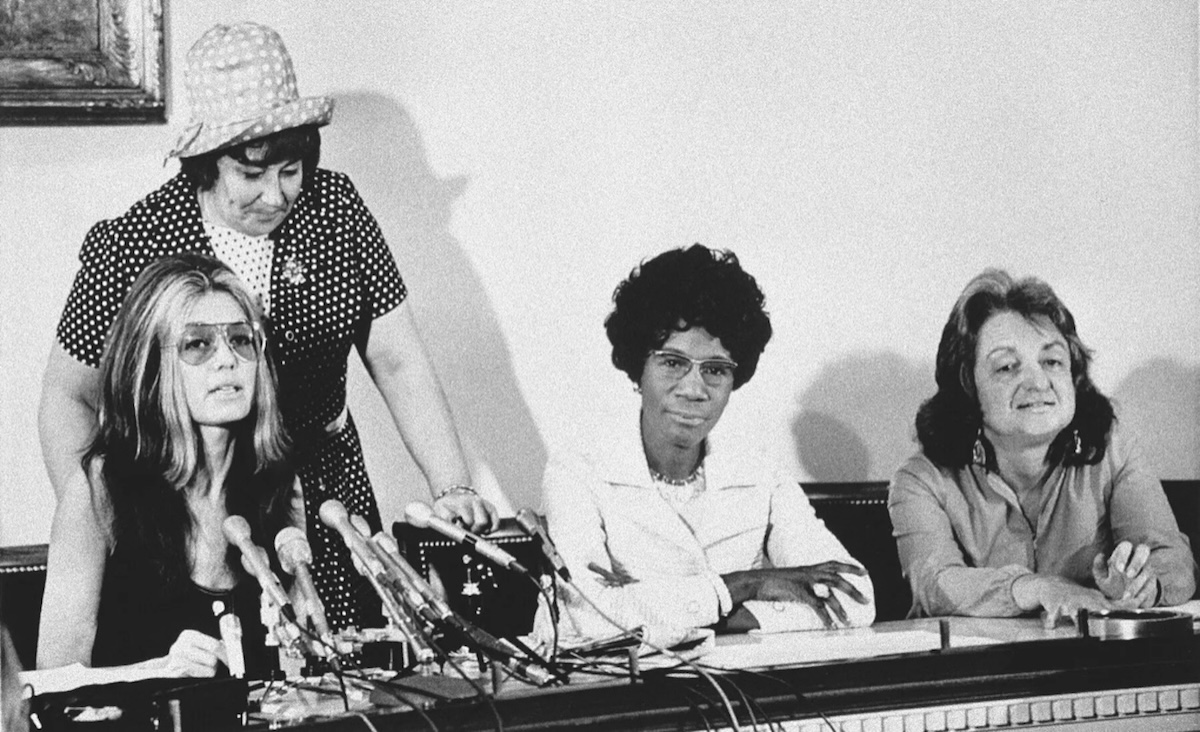

We are the glorias!
I posted this photo by Charles Gorry on Instagram last week, along with my thoughts and feelings about Gloria Steinem’s…
...
When I think of the role of the Chief Enabler in an addicted family system, the phrase, “I’m just trying to help,” comes to mind. The way the Chief Enabler helps is to cover for the addict, in an effort to hold the family together. They prop up the addict by doing things like making excuses for them at work: Calling the boss and saying, “She’s going to be out sick today because she has a horrible stomach virus,” when the truths, she’s still drunk from the night before, or deeply hungover, and you can’t wake her up to get in the shower, and go to work.
The enabler will cover up with friends and family, too. He’ll make excuses to family, and even make excuses to their children. “Your Mom’s had a really hard day, and that’s why she’s not having dinner with us.” Meanwhile, Mom is passed out drunk upstairs in bed.
The enabler will tell the family, “We can’t make it to Jackie’s graduation because we have a conflict.” Meanwhile, the enabler is torn about going to the event, because he knows that chances are that his wife will get drunk again, and cause a scene. He’d rather avoid going than be mortified yet again.
The Chief Enabler is an exhausting and thankless role, and what he doesn’t realize is that as the addict descends deeper and deeper into their disease, he is also descending deeper and deeper into his own codependency. The addict is over focused on their substance or behavior, and the chief enabler is over focused on the addict.
The disease of addiction continues because of two things – using/drinking, and enabling. I want to be clear, that like everyone else in the addicted family, the Chief Enabler is doing his best, and I’m not here to judge those efforts. If he knew what would help, he’d already be doing it. But he doesn’t, and in most cases, the family shame runs so deep that he doesn’t ask for help, even though he needs it.
Because the enabler is completely preoccupied with saving the protecting the addict, he will often neglect everything and everyone else, including his children, and himself. He’s often preoccupied to the point of not being able to do his own job, and he’s affected physically, emotionally, and spiritually.
It’s like the parable of the frog in the water: If you have a pot of boiling hot water on the stove, and you throw a frog in it, the frog will immediately jump out of the pot. If, however, you put the frog in a pot of cool water, with a slow heat under it on the stove, the frog won’t even notice that it’s getting warmer, and then hotter, and eventually perish.
Because addiction is so subtle and insidious – the “heat” gets turned up slowly, and the disease progresses – and the enabler doesn’t even notice that things are getting worse.
This all reminds me of someone I worked with in my therapy practice in New York City, a very long time ago. She came to see me because her husband was in the throes of addiction, and she was at her wit’s end.
She worked the swing shift, and when she’d get home at about 12:30 am, he would leave the house, and not come back until it was time for her to go to work again. This happened night after night. They had 2 small children that he was neglecting during the day – because he was sleeping off the night before – and the disease had progressed to the point where everyone in the household was suffering,
I remember asking her, “Why, if it was this bad…why did you marry him? And she replied, “Oh, it wasn’t this bad when we first got married. The two of us used to go out and party a little bit, but then, I stopped, and he kept going.”
Since the Chief Enabler is so hard bent on saving the addict, they find it extraordinary difficult to set any boundaries. They suffer from what we call the “empty threat syndrome.” They want the addict to stop, but they’re not willing to sit with the discomfort of saying no; the discomfort of not covering up for them – often because they don’t know how, and they don’t have the support – the necessary support – in their lives to do so.
So they might set a boundary:
“If you show up drunk, I’m not going to let you in the house.”
“If you come home late, I’m not gonna save dinner for you. I’m gonna put the kids to bed and not worry about you at all.”
“If you don’t stop, I’m going to leave you.”
They make the threat, and then they don’t hold the boundary.
The addict comes home under the influence, and they let them in the house.
They save dinner for them.
They don’t leave.
The addict quickly learns that the enabler is going to make threats, but they’re not going to uphold them. So they push through the boundary, and eventually the enabler gives in. Then at some later point, the enabler gets fed up again, sets another boundary, doesn’t follow through, and the cycle continues.
Those empty threats contribute to the progression of the illness, and the enabler ends up feeling horrible about themselves. They want to blame the addict, but the truth is, they’re allowing the behavior.
Enablers need to feel needed, because of their own history of trauma, neglect or abandonment. They seek out helping other people to feel validated, so that they can feel a sense of self, and feel a sense of value in the world.
Another big issue for enablers is what I call fear of codependent unemployment. The Chief Enabler has been so caught up in taking care of the addict that it’s been like a full time job, and they can’t stop. That same drive that led them to “save” the addict can’t just be turned off on a moment’s notice, any more than the addict can “just say no,” with their disease.
The inclination for the enabler is to do something for the addict before they’ve even been asked, which is a sure sign of enabling and codependency.
Just to be clear, I’m not talking about anticipating the needs of someone who you’re supposed to do that for: your job as a parent, for example, is to react to your young child’s needs before they even ask: to feed and burp them, bathe them, change their diaper, dress them, etc. You’re supposed to anticipate those needs until the child reaches an age where they can do it for themselves, and or they can ask for help when they need it. The same is true if you have agreed to care for an elderly person, or a person with a disability: anticipating their needs is often necessary.
And please don’t confuse this with being kind: We do kind things because it’s the right thing to do. I have a neighbor who broke his foot and has been in a walking boot. Every day chores are a hassle, so I knock on his door before I go to grocery store to say, “Hey, you need anything?” I’m not anticipating his needs: I’m asking if I can help as a kindness.
The difference is that when you are overly anticipating what your able bodied significant other or adult child needs, you’re inhibiting their ability and responsibility to care for themselves. And when you’ve got somebody else front and center in your life that is capable of taking care of themselves, you’re neglecting you.
Enabling takes a toll. Studies have shown that there are a vast amount of emotional and physical ailments that happen as a result of being an enabler: Cardiovascular problems like high blood pressure or palpitations; gastrointestinal problems, like ulcers, or colitis. Sleep disorders like insomnia and nightmares. How can you sleep soundly when your child or significant other is out getting loaded, and you don’t know where they are, if they’re okay, or if they’re going to make it home safely?
Catastrophizing in their mind what might be happening to their loved one also contributes to emotional issues, like depression or anxiety, and it absolutely contributes to a lack of intimacy in the relationship.
Because the enabler is so highly distracted, they’re often clumsier – bumping into things, knocking things over – making mistakes and/or forgetting things. It can impede their capacity to be a good employee, a good enough parent, a good friend, etc. It’s hard to be present in any relationship when you’re preoccupied.
And then the truth is, some enablers take on the attitude of “If you can’t beat ‘em, join ‘em,” and they start drinking or using, too. They get caught up in the disease of addiction as well, so then you’ve got children with 2 impaired parents. [There will be more about the roles the children take on in response, in the next 4 posts.]
Since people so often focus on “saving” the addict, they miss that enablers need help, too. They need a support system: Other people who have been through what they’re going through, therapy/counseling and/or recovery meetings like Al-Anon or Nar-Anon, which are the sister programs of Alcoholics Anonymous and Narcotics Anonymous. They need support to be able to hold boundaries, the same way the addict needs support to abstain from their behavior, one day at a time. They’re going to get a lot of pushback from the addict, and possibly from the addict’s family, too, and it takes strength to stick to their boundaries.
There are 2 slogans in Al-Anon that come to mind when it comes to recovery for the enabler. The first one is, “Keep the focus on yourself.” Think about what you need. Take action around what you need. Stay focused on yourself and your life, and your job, and your friends, and your children, etc. This takes a lot of practice. The enabler has so unconsciously stepped in to fix things, that it’s going to take conscious effort to break that habit. Expect that it will be uncomfortable. They’ll think they’re “hurting” the addict, but it’s actually helping them to have to face their disease, and get hopeful, get help.
The other Al-Anon slogan is “Don’t just do something, sit there.” That doesn’t mean to sit on your hands and suffer, it means don’t take action to protect, defend, and enable the addict. Again, this is going to take conscious practice, as it will be going against a compulsive energy in the body to check on, and care for, the addict. It, too, is going to be difficult to sit with the discomfort of not going it, and that will also take time – and conscious effort – to shift.
I don’t recommend trying to break these habits without help. Again, that could mean therapy, or Al-Anon, or Nar-Anon, or any other kind of support group that will help you. But it also means getting back to your own life, instead of centering it around the addict: Go out for coffee or a meal with a friend, go out for a walk, journal, pray, meditate – anything that you can do to not step into that enabling behavior is a victory.
Even if the addict never gets help, the enabler deserves a happy and peaceful life free of enabling. They deserve to have their life back, and I’m here to tell you, from my own experience, that it’s possible.
My invitation for this post – even if you’re not what you would consider to be an enabler – is to think about when you inappropriately anticipate somebody else’s needs and take care of them, rather than allowing them the dignity of taking care of themselves.
Is there something you can do to shift that urge or action you take? Even just being aware that you’re doing it is a shift. You don’t have to go cold turkey. Just start to notice when you’re doing it, and then check in with yourself to see if you can get some clarity about why, and what it might feel like to not.
This material is protected by copyright.
__________________________________________________________________________________________________________________________________________
About Jean:
Jean Campbell, LCSW, SEP, TTP, TEP has been bringing together groups of people to heal for over 31 years. She blends her extensive experience in psychodrama, sociometry, group psychotherapy, somatic healing and trauma resolution to offer training for helping professionals, personalized intensives, clinical consultation, and leadership workshops. You can find her at theactioninstitute.com, on Instagram at @actioninstitute, and on Facebook at @actioninstituteofcalifornia.
I posted this photo by Charles Gorry on Instagram last week, along with my thoughts and feelings about Gloria Steinem’s…
...
As a follow up to my last post about chatbots, I’ve been thinking a lot about why they’re so popular,…
...