
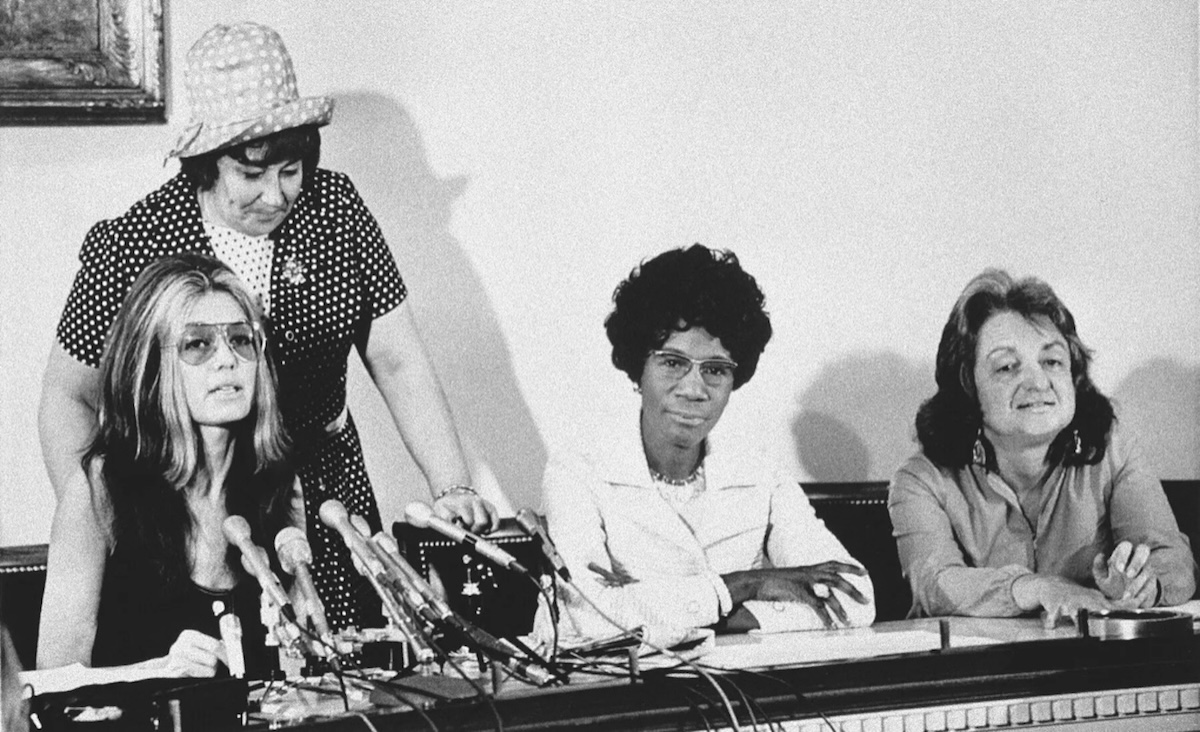

We are the glorias!
I posted this photo by Charles Gorry on Instagram last week, along with my thoughts and feelings about Gloria Steinem’s…
...
How often do you say negative things to yourself and not even notice it?
Are you even aware of how you talk to yourself?
The truth is, most of us aren’t.
We all have them – those self-judgmental voices that spew negativity and shame and won’t leave us alone. All day long, they barge into your mind, filling your head with nasty messages about who you are, what you look like, what you’ve done, what you haven’t done, blah, blah, blah. Like PigPen’s patch of dust, that Itty Bitty Shitty Committee is ubiquitous.
For a lot of us, because the self-judgmental voice is so loud, it’s hard to find the one of self-compassion – the counterbalancing voice of what is good about us. Messages like, “Look what you DID do today,” or “You look fabulous today,” or “You’re a great friend.”
If the answer is self-judgment, I’m here to tell you, you weren’t born with those voices. You didn’t ask for them, and you don’t deserve them. Not at all.
When a person I’m working with says something judgmental about themselves, I invite them to pause and ask themselves, “Whose voice is that?”
More often than not, the response I get is, “It’s mine.” And my response back is, “Well…it is now, but you didn’t come out of the womb with that voice. Someone gave it to you.”
When you’re a baby, everything is about you: The blanket is about you, the diapers are about you, the bottle or the breast is about you, etc. In order to move outside that realm – and let’s face it, some people never do, but that’s a subject for a different post!
In order to move outside of that, you need to be what in psychodrama we would call mirrored, or have others reflect back to you who you are. To travel that developmental phase in a healthy way, you need a balance of positive, negative, and neutral mirroring.
Here are examples:
A positive mirror, “You have a beautiful voice.”
A negative mirror, “You’re so stupid.”
A neutral mirror, “You have green eyes.
The reason babies and young children need to hear neutral mirroring is because as they’re learning about themselves, and the world, they need to know what we call things. So statements like, “You’re wearing red shoes,” or “You’re tall,” help them sort out who they are, and the world around them.
Neutral mirroring doesn’t have a charge one way or another. It’s not good or bad. It just is. So you got mirrored by the people in your life: Parents, siblings, teachers, coaches, clergy, etc.
If that mirroring was mostly negative, and those people reflected back to you more of what was wrong with you than what was right with you, then you likely learned to make that critical voice your own, to listen to it more often than the positive one, and you carry it around in your head and in your body.
You integrated those negative messages so well that you don’t need those people judging you anymore – you’ve gotten pretty good at doing it to yourself.
The not so good news is that it requires work to change it.
One of the people I look to, to help me deepen my understanding of and practice of self-compassion, is Dr. Kristin Neff. She’s done a tremendous amount of work on the subject.
And when I was looking at her website recently – self-compassion.org, I had an aha moment. I realized that not only do I walk around with that voice of self-judgment inside of me, but there’s also a big part of me that believes it.
For example, when I start to work on something like a Substack post, my self-judgmental voice says, “Why bother? Nobody cares what you think.”
The part of me that believes that voice responds, “You’re right. If I can’t do it perfectly, I’m not going to even try, so I think I’ll just watch TV instead.”
Before you know it, I’m walking away from the computer, and picking up the remote. If I was ever going to start my Action Insights podcast, or a Substack account, or work on any project, I had to be willing to find, and build up, my voice of self-compassion. But how?
Based on Neff’s work, the psychodramatist in me knew that just thinking about it wasn’t going to solve it. I needed action.
Those of you who are familiar with the empty chair exercise might think of Gestalt therapy, but it might interest you to know that the creator of Gestalt, Fritz Perls, actually trained with the creator of psychodrama, Dr. Jacob Moreno.
In order to address my Itty Bitty Shitty Committee, I pulled out 2 chairs – one for me and one for my inner critic. I started in my chair, and then reversed roles (moved from my chair to the other chair) and took on the role of the inner critic, which in my case is my father’s voice.
Now, my father was an amazing man, and I’m not trying to bash him. I think he was actually quite self-critical because he was so driven to succeed, and I’m sure he thought by giving me criticism that he would encourage me to do the same. But that voice doesn’t motivate me – it gets in my way.
When I sat in the inner critic chair, that voice said, “No one wants to hear what you have to say. Starting a podcast was a terrible idea.”
I then got up from that chair and went and sat in a third chair – because when we do psychodrama, different roles have different places in the space. When I sat in the third chair, I took on the role of the part of me that believes that voice.
And what came out of me is, “You’re right, whatever possessed me to do that.”
This was my choice point. I could either believe those voices or I could find a positive one. So I sat in yet another chair and took on the role of self-compassion. And what I said in that seat was, “Doing a podcast – especially one where you share things about yourself – is really vulnerable. And of course you’re feeling nervous about it.
But you know that vulnerability is actually the place where people connect. And you’ve got years and years of experience with connection. And by the way, you’ve already gotten some good feedback about the podcast. So don’t listen to those other voices. Listen to me and keep going. “
And when I reversed back to myself – and allowed myself to hear that self-compassionate voice in my heart – it encouraged me, and it gave me permission to keep going. I de-roled the chairs, so they were just chairs, and sat for a few minutes to integrate that self-compassion voice before moving on with my day.
It’s still scary to put up a podcast into the world – or a Substack post – but every time I put something out there in the world, I remember what Eleanor Roosevelt said,
So my prompt for this post to you is to notice how you talk to yourself.
Is it from a place of self-compassion or from a place of self-judgment? And if it’s the latter, can you find an alternative voice of support – either inside yourself or outside yourself, meaning someone you can trust and who supports you? Can you listen to that supportive voice instead, so you can take the next vulnerable action in your life?
And if you’re a clinician who wants to learn how to use psychodrama and action methods in your work – including how to find and integrate a voice of self-compassion – come to one of our upcoming virtual or in-person trainings.
This material is protected by copyright.
_________________________________________________________________________
About Jean:
Jean Campbell, LCSW, SEP, TTP, TEP has been bringing together groups of people to heal for over 30 years. She blends her extensive experience in psychodrama, sociometry, group psychotherapy, somatic healing and trauma resolution to offer training for helping professionals, personalized intensives, clinical consultation, and trial preparation consultation. You can find her at theactioninstitute.com, on Instagram at @actioninstitute, and on Facebook at @actioninstituteofcalifornia.
I posted this photo by Charles Gorry on Instagram last week, along with my thoughts and feelings about Gloria Steinem’s…
...
As a follow up to my last post about chatbots, I’ve been thinking a lot about why they’re so popular,…
...