


Orient to pleasure
Given all that’s going on in the world, our nervous systems are activated, and with good reason. Many of us…
...
I listened to Brene Brown’s multi-episode discussion on her podcast, Dare to Lead, regarding her new book, Strong Ground. She had organizational psychologist Adam Grant join her for that series, and in Episode 4, they talked about the difference between empathy and enmeshment.
Brown has a long history of researching, talking about, and writing about empathy, and for the most part, I have been in agreement with her, until now.
With tremendous respect for the research and writing that both Brown and Grant have done over the years, I found myself disagreeing with them, and it was very clear to me that neither of them is a practicing clinician.
Brown’s belief – which is explained in a short animated video on her website is about the difference between empathy and sympathy. According to Brown, sympathy is characterized by feeling sorry for someone, while empathy is feeling with someone rather than for them.
On the podcast, Grant talked about the difference between cognitive and affective empathy – affective meaning feelings. He acknowledged that a lot of people suffer from empathic overload and, ironically, they end up less kind and less generous to others because they feel so much of other people suffering, so they have to escape or withdraw.
And he’s right when he says that that’s not healthy or sustainable. The behavioral part of empathy he talks about is the action involved in compassion. As he says, “I do not need to feel your feelings or know exactly what it’s like to be in your shoes, in order to care about your feelings and want to alleviate your suffering.”
This is where he loses me, but I’ll get to that in a moment.
Brown goes on to talk about the fact that she disagrees with him, too. She believes we need both empathy and compassion, but she defines the difference between cognitive empathy and compassion, not affective empathy.
And for her, affective empathy is when somebody has fallen into a hole, and you jump into the hole with them. Her argument is that if you do that, you’re enmeshed with that person rather than actually feeling empathic. The type of empathy she suggests is called cognitive empathy, which comes out of the work of Teresa Wiseman.
Cognitive empathy, according to Brown, is, “…to listen, to understand and believe someone’s experience, even when it’s different from your own.” She goes on to say, “I think that without it, compassion is almost bankrupt. Compassion means to witness suffering and take action. “
And as I was letting all of this percolate in my mind and in my body, I was particularly thinking a lot about what they call affective empathy, and how I practice it as a clinician.
Because if you’re a baby or a young child, or even an adult that never had anyone help you to know what you’re feeling – or join you in that feeling – then practicing cognitive empathy with that person isn’t going to alleviate suffering. If you don’t have the capacity to know what you’re thinking or feeling, you need someone else to give voice to it, to feel it for you, and with you – to help you identify what you are feeling and what your experience is.
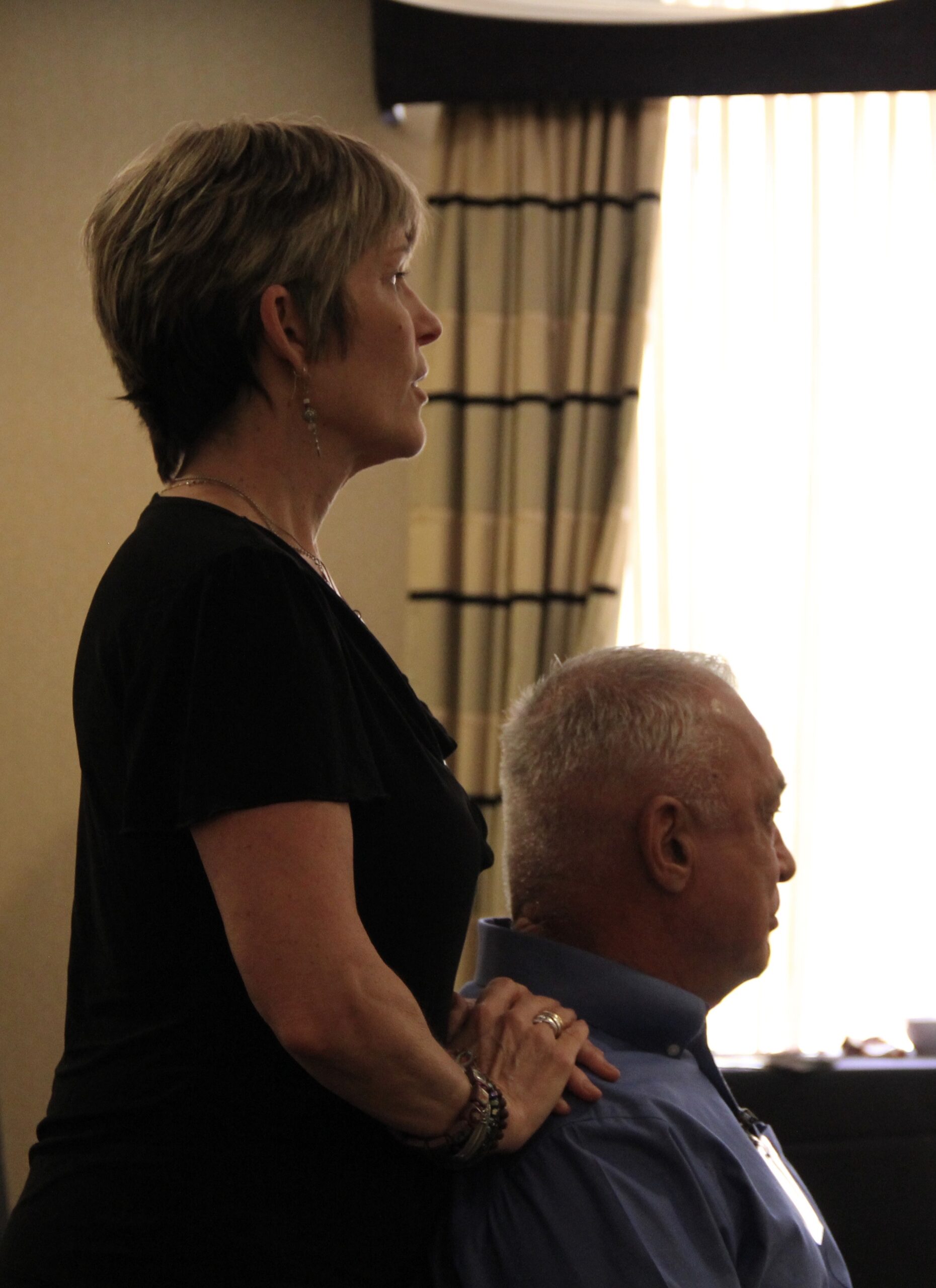
I’ve written about doubling in other posts, but as a reminder, doubling is a psychodrama tool where I, as the director of the psychodrama – or a fellow group member – can temporarily step into the shoes of the protagonist – the person whose psychodrama we’re doing. When we double, we speak for them, or feel for them, to help them feel seen, heard, and connected, and to help them identify what is going on inside of them.
When we use this technique, we physically stand behind the protagonist with permission, or sit or kneel behind them – whatever posture they are in – and we become them for a moment, feeling into their experience. We then speak from what it feels like in their shoes, and then the protagonist can repeat what was said – if it fits – embroider upon it, or change it completely if the doubling statement was wrong, so that they can make it fit for them.
So what we are doing, based on the language of Brene Brown, is stepping into affective empathy. I’m stepping into your shoes, and I have, in her words, gone into the well with you. Here’s the difference, though.
In psychodrama, we believe that when we step into somebody else’s shoes, it’s temporary. We don’t stay there, and it requires a great deal of capacity.
I don’t want to go completely into the psychodramatic developmental process here, but in order to step into your shoes temporarily, it requires that I have enough sense of myself from the inside – which I got from being adequately doubled by others, typically a caretaker at the very beginning of my life. And because I have been adequately doubled, I have a sense of myself from the inside. On top of that, if I’ve been adequately mirrored, which is a term we use in psychodrama, meaning I’ve been adequately reflected back by other people, who I truly am, I have a sense of myself from the outside.
Adequate mirroring means that I have had a balance of positive mirroring, negative mirroring and neutral mirroring. Positive mirroring would be someone saying to me something like, “You’re really smart,” which is a reflection of me from the outside. That helps me anchor who I am on the inside and the outside.
Negative mirroring might be somebody saying to me, “I don’t like it when you speak to me that way, it’s unkind.” That’s going to reflect back to me that I’ve done something wrong, and I can change it. That’s how we learn that our actions can have a negative effect on others.
Then there’s neutral mirroring, which is simply having something reflected back to me that has no charge either way: It’s not positive or negative. So someone could say to me, “You have green eyes.”
Notice again, there’s no charge. It’s just a fact. The reason we need neutral mirroring as children is that we don’t know what things are, and we need to understand what is part of us and what is outside of us. So that’s why neutral mirroring is crucial when we’re children.
We need a balance of all three in mirroring, so we have an accurate sense of who we are on the outside. Now let me get back to doubling.
When I double you – or as Brown would call it affective empathy – because I have enough sense of myself from the inside (because I was adequately doubled), a balanced sense of myself from the outside – positive, negative and neutral mirroring (because I was adequately mirrored) – I can temporarily completely step into your shoes without losing me. And then I can make a doubling statement as though I’m you, or I can make a sound or a movement, or I can help you identify what it feels like inside of you.
Then I can step back into myself, after being service of you in that moment. And when we double in the course of a psychodrama, we are of service to the protagonist.
And that actually, as far as I have learned over the years – and I’ve been trained in a lot of different modalities – that is really the only way I know to help people deeply, deeply believe that someone else gets them. That they get their feelings, their thoughts, their sensations and their experiences, and that all of those things matter, that they matter.
And that, Dr. Brown, is how we alleviate suffering.
You’re not gonna get that by reflecting something to someone or by mirroring them: You’re gonna get that by temporarily stepping into their shoes so they feel joined with.
It’s what was supposed to happen when they were babies and young children.
Doubling is one of the most brilliant things that JL. Moreno, the creator of Psychodrama, came up with. And no surprise, it is the first step in the developmental process.
I am meant to be adequately doubled. Babies and children are meant to have caretakers step into their shoes when they are crying, which is their only means of communication. They’re crying because they’re hungry, crying because they’re tired, crying because they have a burp, crying because they need a diaper change.
Babies and children need others to step into their experience and affect – to feel with them, to help them feel, seen, felt, heard, and to identify what’s going on inside of them. And with time, the child begins to be able to identify what is going on inside themselves without needing to be doubled.
While it sounds like a good idea in theory, because Brown is a mother, my guess is “jumped into the hole” with her own children when they were infants and young children, because that’s what a good parent does.
Now, can we live in that place 24-7? Absolutely not. If someone doesn’t have the capacity to hold on to themselves while doubling someone else – or stepping into their shoes – then they could get stuck in enmeshment.
But if we can’t step out of ourselves temporarily to double infants and young children, then how are we ever going to raise healthy human beings? And when I say raise healthy humans, I also mean parenting people who never got properly parented.
So my invitation in this post is to think about a time when somebody “got” you so well, so deeply that they could actually speak for you.
It could have been through words. It could have been through a look on their face. It could have been through a hug.
But think about when has that ever happened in your life?
And if you have stepped into someone else’s shoes and gotten lost there, let me say that I have been there? Let me recommend a program called Codependents Anonymous, where you can learn how to identify the need for boundaries in your life and how to set them and keep them. Or maybe you can find a good therapist in your area who can help with that.
And if you’ve never had the experience of someone getting you, really getting you, you can still have that. And you deserve it!’
This material may be protected by copyright.
Given all that’s going on in the world, our nervous systems are activated, and with good reason. Many of us…
...
How often do you say negative things to yourself and not even notice it? Are you even aware of how…
...