
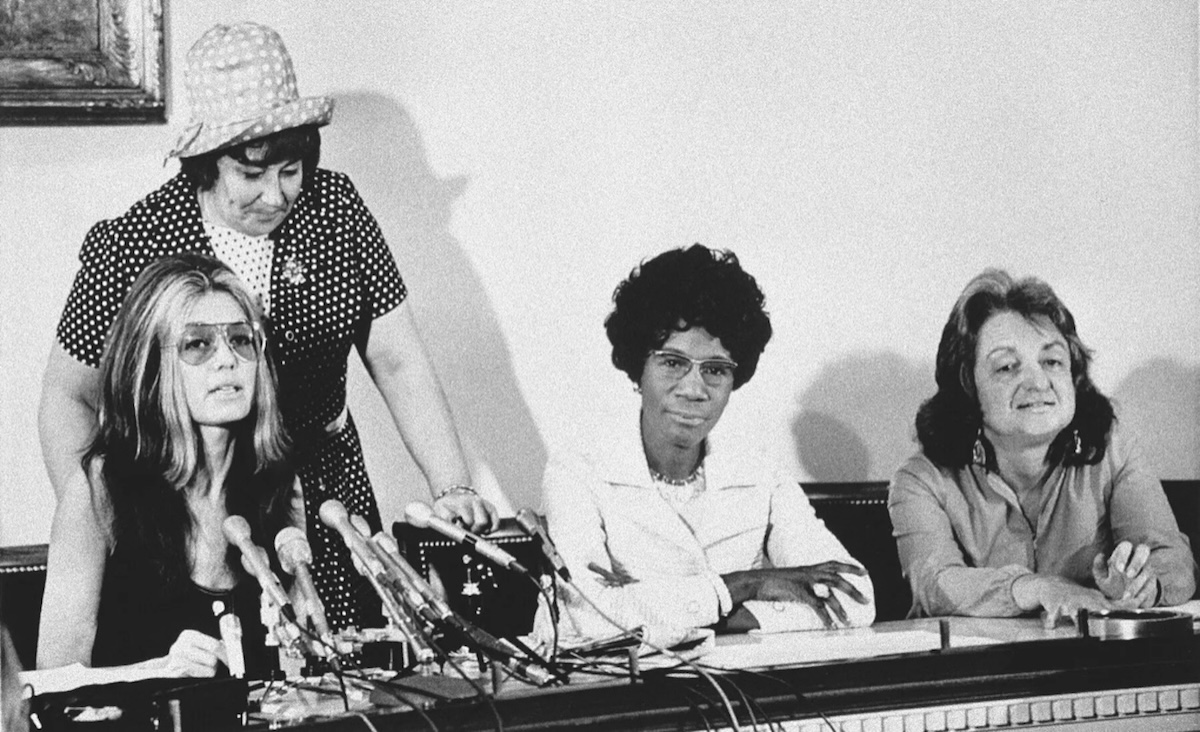

We are the glorias!
I posted this photo by Charles Gorry on Instagram last week, along with my thoughts and feelings about Gloria Steinem’s…
...
I’ve been a sports fan pretty much my entire life. Growing up in New York as a kid, I remember how excited my brother was when the New York Jets won the Super Bowl, and just how thrilled my grandmother was when the 1969 Mets won the World Series that same year. And in 1986, it happened again, except it was the New York Giants who won the Super Bowl, and I actually got to be at Shea Stadium when the Mets won the World Series later that year.
The thing that I love about being a sports fan is that it brings people together. At our core, as human beings, we want to feel connected, and sports allows that to happen. That’s at the core of Sociometry, a modality created by Dr. JL Moreno. We start at the periphery by finding out simple things we have in common – we both are fans of a certain team, or we both have children (or don’t), we’re living in a place that’s different from where we grew up, etc. And then through a series of exercises, we find out more and more about one another, and we end up revealing more and more about ourselves, because a sense of safety has been co-created.
Case in point: I went to a baseball game last week, to a stadium that isn’t even my team’s (with deep gratitude to a friend who gifted me her season tickets, because she wasn’t using them that night). I wanted to see a former NY Mets player, who is my favorite, play again (he was a free agent in the off season and signed with a the Baltimore Orioles).
There was a guy sitting a couple of seats away from me, who had on an Orioles jersey, and he and my friend and I chatted throughout the whole game – initially about baseball. As we got talking more and more, the conversation shifted to topics other than baseball, and it just flowed.
I’ve had that same experience every time I go to a stadium or a sports bar. People who are complete strangers start talking to me, or I to them. Now, it helps that I know baseball – I know the rules, and I know who’s at the top of each division – and I know most of the players in both leagues. But even when I don’t, I can ask someone, and believe me, sports fans are quite happy to tell me more about their team.
These are the initial shared connections that can lead to us asking more questions about one another: How long have you been a fan? Who’s your favorite player? Who taught you the rules of the game? Did you play baseball as a kid?
Meeting new people can be a little scary. We don’t know what’s going to happen. We don’t know if we’re going to be welcome, or if it’s going to be safe, or if we’re going to get along with each other. Here was a guy alone in a strange city, alone in a stadium that wasn’t his, and he got to feel connected and at home, all because of baseball.
The same is happening with the World Cup. In video after video that I’ve watched on Instagram and YouTube over the last 2 weeks, visitors from other countries have said that they were anxious about coming to the US this year. The news that they’ve been watching in their home countries has painted a picture of a dangerous place.
And let’s be honest, players – and even coaches and officials from other countries, like Iran and Somalia – have been deported or denied visas, or not allowed to come at all. Because of US policy, for example, the Iranian team has been forced to stay in Mexico, even when their matches have been in the US. Iranian fans have been denied entry to the country. Fans from other countries have reason to be worried.
Most of the visitors, however, according to the videos I’ve watched, have been pleasantly surprised at what they’re finding here in the US and how kind and welcoming the people are.
As worldwide visitors have come here, their prejudice – their pre-judging – has shifted. Discernment and judgment are important: They help us to categorize people, and know what we need to be aware of so that we can stay safe. But as these World Cup fans have come to visit our country, they have found that Americans want to learn about their culture, too.
For example, in Lawrence, Kansas, the locals have welcomed the Algerian team and their fans with open arms. They’ve even hired chefs to cook Algerian food in the city’s restaurants, and asked musicians to play Algerian music. I’ll admit my own prejudice: I would have never expected that people from the very red state of Kansas would welcome from an African county, with such warmth.
It’s evidence that despite the actions of petty and vindictive world leaders, at our core as human beings, we want to be known, we want to be seen, we want to be understood, we want to be connected.
It’s been such a joy to witness the positive energy that has spread through the United States, as a result of the World Cup: the Tartan Army from Scotland playing bagpipes through the streets of Boston and Miami, the Norwegian fans with their Viking rowing ritual at games, and even on a New York City subway; visitors from Japan and England raving about Texas barbecue. The delight of them discovering ranch dressing had even led to the TSA urging tourists, through posts on Instagram, to put any large bottles of ranch they’ve purchased into their checked baggage, so TSA doesn’t have to confiscate them.
And then there’s the excitement of the matches. Conversations in a sports bar can start by talking with someone you don’t know, and saying, “Are you Team Messi or Team Ronaldo?” And before you know it, you’re talking about how much your daughter wants to be just like Abby Wambach or Mia Hamm, who both won Olympic gold medals on Team USA. The game you’re watching is the initial icebreaker, but as you watch the match together, more and more of your stories unfold, and you learn more about the people around you.
It got me thinking about how the same thing happens in 12-step meetings like Alcoholics Anonymous. I have a sober friend who told me that when he was sitting in a meeting once, he happened to look down at the shoes that people were wearing. And someone who was wearing a pair of Manolo Blahniks, which are incredibly expensive shoes, was sitting next to a guy who had on construction boots that were covered in dust.
And sitting on the other side of her was somebody who quite literally had holes in the bottom of her shoes. None of it mattered to anyone in the room. People are just people, and they were there for a common purpose – to stay sober and to help the alcoholic who still suffers.
People find the common purpose, whether that is sports or recovery or hiking or knitting or playing video games. They come from incredibly diverse backgrounds and have completely different stories; they differ in things like socioeconomic status, level of education, gender identity, sexual orientation, race, religion, and political party.
None of it matters.
Whether your World Cup team is competing or not, if you’re watching the game, it means that you love soccer – or as it’s called in most of the world, football. That’s all people need to know to start building connection.
Watching the fans from all over the world has reminded me of a Mark Twain quote, “Travel is fatal to prejudice, bigotry and narrow mindedness.” We have seen incredible evidence of that over the last couple of weeks.
The fans get to celebrate together when their team wins and commiserate together when they don’t. And sometimes it’s even the opposing team’s fans who offer comfort, as I witnessed this week when a Japanese fan was crying after his team was eliminated in a match against Brazil, and it was the Brazilian fans who were hugging him as he cried.
I watched an incredibly moving video of a Congolese man alone in the stands at a match, completely surrounded by Colombian fans – who the DRC was facing in that match – singing his national anthem at the top of his lungs before it started. Only to have those Colombian fans jump up and down for joy with him once the DRC anthem ended.
Most of what is showing up on my feed these days is pure horror – the war in Ukraine, the devastating earthquakes in Argentina, ICE agents abducting people without a warrant, the continuing genocides in South Sudan and Gaza (just to name a few). But for these precious few weeks, watching such kindness – from people from all over the world, and from my fellow Americans right here at home – has restored my faith in humanity.
My invitation for this post is to think about a time when you sat next to a stranger, on an airplane, at a sporting event, at a 12 step meeting, on line at a bank or grocery store, and how at first, you thought, “I have nothing in common with this person other than we’re both in this same place at the same time.” But then little by little, you got to talking, and learned that on a deep level, we’re all connected.
I’ll invite you to remember that feeling the next time someone tells you that those “other” people are dangerous or weird – or whatever the projection or prejudice it is that they’re spewing onto others.
At our core, people are people, and we have more in common than we could ever imagine.
This material may be protected by copyright.
____________________________________________________________________________
About Jean:
Jean Campbell, LCSW, SEP, TTP, TEP has been bringing together groups of people to heal for over 31 years. She blends her extensive experience in psychodrama, sociometry, group psychotherapy, somatic healing and trauma resolution to offer training for helping professionals, personalized intensives, clinical consultation, and leadership workshops. You can find her at theactioninstitute.com, on Instagram at @actioninstitute, and on Facebook at @actioninstituteofcalifornia.
Watch Jean’s TEDx Talk on Psychodrama by clicking the link below
I posted this photo by Charles Gorry on Instagram last week, along with my thoughts and feelings about Gloria Steinem’s…
...
As a follow up to my last post about chatbots, I’ve been thinking a lot about why they’re so popular,…
...