
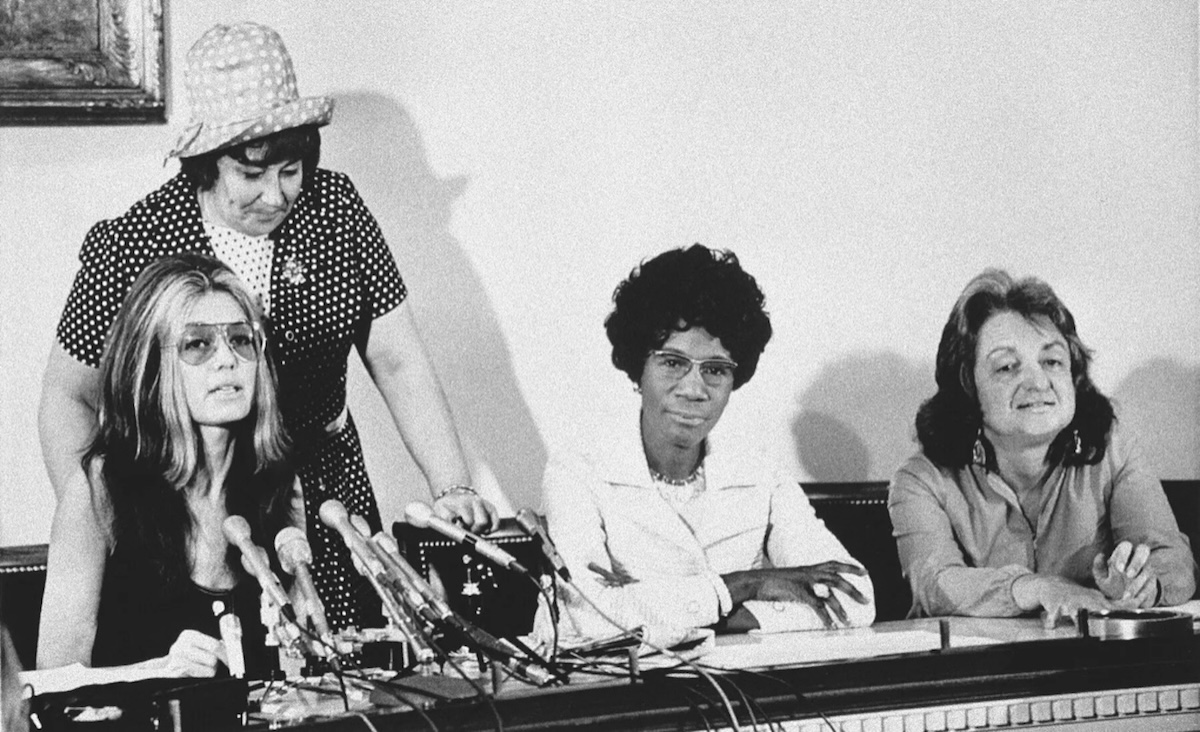

We are the glorias!
I posted this photo by Charles Gorry on Instagram last week, along with my thoughts and feelings about Gloria Steinem’s…
...
I don’t know about you, but in the last couple of weeks, rather than doom scrolling, I have been hopescrolling on social media: I’ve been actively looking for things, posts or stories that will offer me a sense of hope.
You might have heard of the concept of orienting to pleasure, which is a technique I learned about when I studied Somatic Experiencing. Orienting means looking around, and we can do it from what’s called a defensive perspective – when we are determining if there is an actual or perceived threat – or we can do it from what’s called an exploratory perspective, which simply means looking around a space, which we all do multiples times in the course of a day.
Orienting to pleasure means that we’re actively looking for things – through all 5 of our senses – that bring pleasure: A breeze moving through the trees; hawks circling in the sky; watching a child playing and laughing; tasting a yummy cup of coffee or tea; hearing the sound of the ocean waves; smelling a delicious scent in the air. These are all things that we can perceive as pleasurable, and which can balance out the defensive posture we are currently living with, given all that’s going on in the country, and the world right now.
One of the things I’ve been seeking out is poetry. Some of the poems that are bringing me solace are The Peace of Wild Things by Wendell Berry; Still I Rise by Maya Angelou; For One Who Is Exhausted, A Blessing by John O’Donahue; Wild Geese by Mary Oliver; Hope Is The Thing With Feathers by Emily Dickinson.
But the thing that has continued to offer me the most hope in the last few weeks – something that I have written about in a prior post – is the Walk for Peace.
The Buddhist Monks on the Walk for Peace have walked through Texas, Louisiana, Mississippi, Alabama, Georgia, South Carolina and now North Carolina. Every one of those states that I just listed is part of the Bible Belt, and I would never have expected residents of mostly Christian states to show up to see Buddhist monks. And yet they have been showing up by the thousands, at all hours of the day – from very early morning until the monks stop walking that that evening. These folks have been sitting or standing by the side of the road waiting for hours, sometimes in rain, or snow, or bitter cold – many with tears in their eyes – as they watch the monks walk by, offering them flowers, food, water, and even little kids offering them drawings.
And I was particularly stunned by the city of Columbia, South Carolina, a city where 73% of the population identifies as Christian. In that city, there were thousands upon thousands of people who not only lined the side of the road, but when they were invited by the monks to walk with them across a bridge, it looked like human gridlock. There is so much pain and fear in this country right now – and in the world – that people are hungry for hope and peace and grounding and connection.
And even though I’m not seeing these monks in person, they have offered me all four of those. I weep with gratitude at every video or photo of them I see, because in the midst of such a painful time, I’m reminded that there is another way for us to live.
Just watching the simplicity of them walking, just being of service by chanting and walking for peace, with no political agenda and no expectation that the gift they are offering will be returned.
It has brought me so much peace and so much hope. Their walking meditation is a prayer for all of us.
So it got me thinking about what simple things I can do to be of service to others. In the recovery groups I’ve been a part of for over 30 years, one of our principles is being of service. It’s a way that we hold on to our own recovery.
As an example, Bill Wilson, the co-founder of Alcoholics Anonymous, discovered when he reached out to help another alcoholic early in his sobriety, even if that person didn’t stay sober, Bill did. It was in the doing of service that he continued to maintain hope and a willingness to persevere in his sobriety.
And all these years later, we have the science to back up that being of service, and helping someone else, actually lifts our mood. The pleasure center of your brain, otherwise known as the VTA – Ventral Tegmental Area – gets stimulated when you help people. When you are of service, you get a boost of dopamine, which is a feel-good neurotransmitter and hormone.
So whether it’s donating food or clothing, or even money, or volunteering in an animal shelter, or maybe shoveling your elderly neighbor’s driveway after a snowstorm, or sending a simple text to a friend or a family member or a coworker that says something as simple as, “Hey, I was just thinking about you. How are you doing?” They’ll feel better, and you’ll feel better, too.
If you’re looking for a burst of hope, you don’t need to be watching The Walk For Peace, although I do highly recommend it. All you need to do is take action, to be of service, and as a positive by-product of your action, you get a dopamine hit.
So that is my invitation: Find a simple, doable way to be of service – to a friend, a family member, a co-worker, a neighbor, or to a complete stranger.
You could hold a door open for somebody as they’re coming into a place that you’re leaving. Find a way to be of service, and you’ll feel better.
It’s neurobiology. And your body, soul and spirit will thank you. Easy does it.
This material may be protected by copyright.
I posted this photo by Charles Gorry on Instagram last week, along with my thoughts and feelings about Gloria Steinem’s…
...
As a follow up to my last post about chatbots, I’ve been thinking a lot about why they’re so popular,…
...